
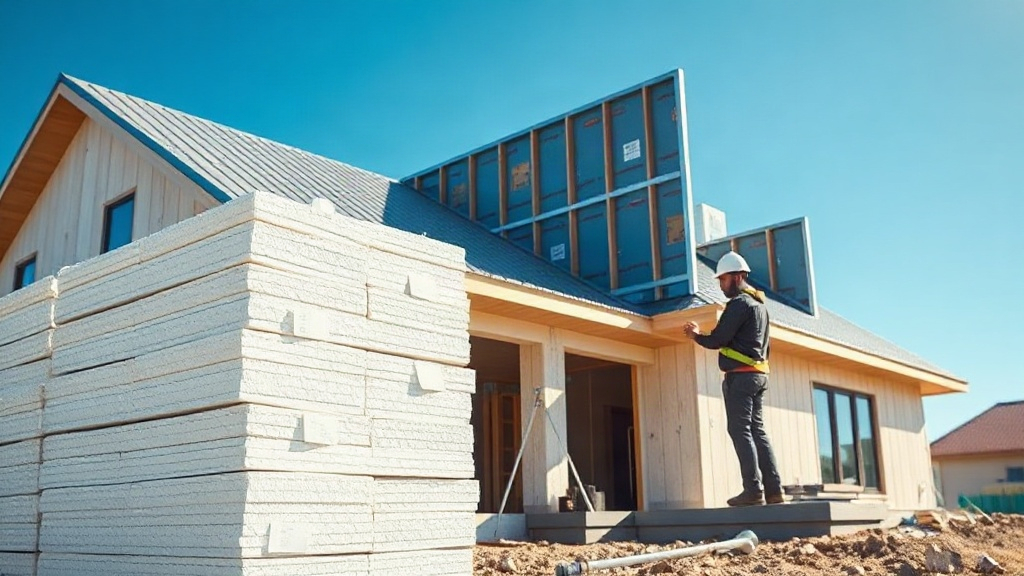
If you're planning a construction or renovation project, you've probably heard about eps insulation as a budget-friendly option. But what does it actually cost? In this guide, I'll walk you through the real numbers, based on my experience sourcing materials for residential and commercial projects. You'll learn what affects pricing, how to compare quotes, and why insulated roof panels might be the smartest investment you make.
What Is EPS Insulation and Why Does It Matter?
EPS, or expanded polystyrene, is a lightweight, rigid foam made from tiny beads of polystyrene that are expanded with steam. It's one of the most cost-effective insulation materials on the market, offering good thermal performance at a fraction of the cost of polyurethane or mineral wool. You'll find it in walls, roofs, and floors, often as boards or as part of structural panels.
Unlike some insulation types, EPS doesn't absorb water easily, resists mold, and can last for decades if installed correctly. That durability translates to long-term savings on energy bills, which is why builders and homeowners alike keep coming back to it.
How Much Does EPS Insulation Cost?
The price of eps insulation cost varies depending on thickness, density, and where you buy it. As a general rule, expect to pay between $0.50 and $1.50 per square foot for standard EPS boards. That's for the material alone; installation adds another $0.50 to $1.00 per square foot if you hire a pro.
But that's just a starting point. Let's break it down by application.
Wall Insulation
For exterior walls, you'll need thicker boards to meet energy codes. A 2-inch EPS board (R-value around 8) costs roughly $1.00 to $1.50 per square foot. If you're retrofitting, add the cost of removing old siding or drilling holes for injection foam, which can double the labor.
Roof Insulation
Roofs are trickier because they're exposed to the elements. Here, insulated roof panels (also called SIPs or sandwich panels) are a popular choice. These panels combine a thick EPS core with structural skins, often OSB or metal. A 4-inch panel with an R-value of about 16 costs $4 to $8 per square foot, including the structural benefits. That might sound steep, but you're replacing both insulation and framing, so the net cost can be lower than traditional stick-built roofs.
Floor and Foundation Insulation
For floors over crawl spaces or slabs, EPS boards are a cost-effective way to stop heat loss. Expect to pay $0.75 to $1.25 per square foot for 1-inch boards. Installation is straightforward, but you'll need to seal edges to prevent air leaks.
Factors That Affect EPS Insulation Cost
Not all EPS is created equal. Here's what moves the needle:
- Thickness and R-value: Doubling thickness roughly doubles cost, but R-value doesn't scale linearly; check the product specs.
- Density: Higher-density EPS (e.g., 2 lb/ft³) costs more but offers better structural strength and moisture resistance.
- Quantity: Buying in bulk or directly from a manufacturer like epswallpanels.com can cut costs by 20% or more.
- Location: Prices vary by region due to shipping and local demand. Coastal areas tend to be pricier.
- Installation method: DIY saves labor but requires careful detailing to avoid gaps.
Comparing EPS to Other Insulation Materials
EPS isn't the only game in town. Here's how it stacks up:
- XPS (extruded polystyrene): Slightly higher R-value per inch, but 20-30% more expensive and less eco-friendly due to blowing agents.
- Polyiso: Better performance in cold climates, but costs 50% more.
- Mineral wool: Fire-resistant and sound-absorbing, but nearly double the price of EPS.
- Spray foam: Excellent air sealing, but can be 3-4 times the cost of EPS.
For budget-conscious projects, EPS often wins. However, if you need high R-value in a tight space, you might need to splurge on a premium material.
Why Insulated Roof Panels Are a Game-Changer
If you're building a new home or adding a room, consider insulated roof panels. These prefabricated panels combine EPS insulation with structural skins, creating a roof that's strong, energy-efficient, and quick to install. Here's why they're worth the investment:
- Speed: Panels arrive ready to install, cutting labor time by up to 50% compared to traditional framing and insulation.
- Energy efficiency: Continuous insulation eliminates thermal bridging, reducing heating and cooling costs by up to 30%.
- Durability: The EPS core won't sag or settle, and the skins protect against moisture.
- Cost predictability: You know the panel price upfront, so there are fewer surprises.
I've seen projects where the upfront cost of insulated roof panels was 10-15% higher than stick-built, but the energy savings paid back the difference in under five years.
How to Get Accurate Quotes for Your Project
Getting a realistic eps insulation cost estimate requires more than a quick Google search. Follow these steps:
- Measure your space: Calculate square footage for each area (walls, roof, floors).
- Determine R-value needs: Check local building codes; they specify minimum R-values for each application.
- Decide on thickness and density: Match the product to your climate and structural needs.
- Request multiple quotes: Contact local suppliers and online manufacturers. Compare not just price but also delivery time and warranty.
- Factor in installation: If hiring a pro, ask for a breakdown of labor and materials.
Don't forget to ask about volume discounts. Many suppliers, including epswallpanels.com, offer reduced rates for large orders.
DIY vs. Professional Installation
Can you install EPS insulation yourself? For simple wall or floor applications, yes. The material is easy to cut with a utility knife and doesn't require special tools. However, roofs and complex assemblies are best left to professionals. Mistakes like gaps or compressed insulation can slash performance and lead to moisture problems.
If you're handy, DIY can save you 30-50% on labor. But weigh that against the risk of poor installation and potential warranty voidance.
Long-Term Savings and ROI
Insulation isn't just an expense; it's an investment. According to the U.S. Department of Energy, proper insulation can reduce heating and cooling costs by up to 20%. For a typical home, that's $200-$400 per year. Over a 10-year period, you could save thousands, easily offsetting the initial eps insulation cost.
Plus, insulated homes often sell faster and for higher prices. Buyers appreciate lower utility bills and comfort.
Frequently Asked Questions
How much does EPS insulation cost per square foot in 2025?
For standard 1-inch EPS boards, expect $0.50 to $0.75 per square foot. Thicker boards (2-4 inches) range from $1.00 to $2.00 per square foot. Installation adds $0.50 to $1.00 per square foot if you hire a professional.
Are insulated roof panels more expensive than traditional roofs?
Yes, upfront. Insulated roof panels typically cost $4 to $8 per square foot, while a traditional roof with separate insulation might run $3 to $6 per square foot. However, the panels install faster and provide better energy efficiency, often leading to lower long-term costs.
What R-value do I need for my climate?
It depends on your region. The International Energy Conservation Code (IECC) sets minimum R-values: for walls, R-13 to R-20; for roofs, R-30 to R-60. Check with your local building department for exact requirements.
Can I install EPS insulation myself?
For walls and floors, yes, if you're comfortable with basic tools. Roofs and complex assemblies are better left to professionals to ensure proper sealing and performance.
How long does EPS insulation last?
EPS insulation can last 50 years or more when installed correctly and protected from UV exposure. It doesn't degrade or lose R-value over time, unlike some other materials.