
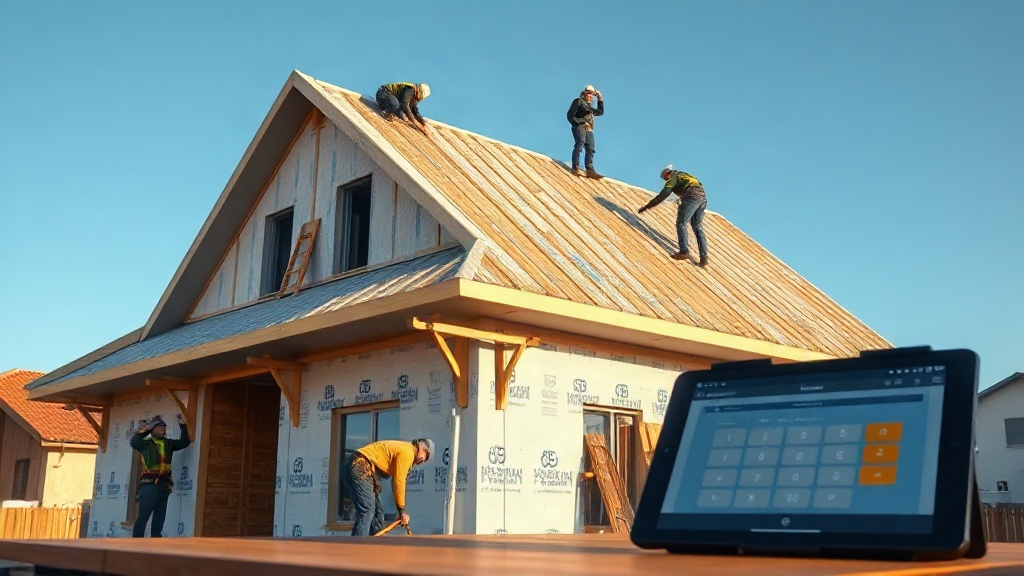
When you're planning a construction or renovation project, getting the insulation right is critical. Too little, and you'll be shivering in winter and sweltering in summer. Too much, and you're overspending on materials. That's where an eps insulation calculator becomes your best friend. It takes the guesswork out of choosing the right thickness and type of eps insulation for your insulated roof panels. In this guide, we'll walk you through how these calculators work, why they matter, and how to use them like a pro. Whether you're a DIY enthusiast or a seasoned contractor, you'll find practical advice to optimize your insulation strategy.
Why an EPS Insulation Calculator Is Essential
EPS, or expanded polystyrene, is one of the most popular insulation materials thanks to its affordability, lightweight nature, and decent thermal performance. But its effectiveness depends heavily on thickness and installation. An eps insulation calculator helps you determine the optimal thickness based on your climate, building design, and energy goals. Without it, you might default to a standard thickness that either underperforms or costs more than necessary. For example, in colder climates like the northern US or Canada, you might need thicker EPS to achieve the same R-value that works in milder regions. A calculator factors in local climate data, your desired indoor temperature, and even the type of insulated roof panels you're using. This precision translates to real savings: according to the U.S. Department of Energy, heating and cooling account for about 50% of a typical home's energy use, so even small improvements in insulation can slash your bills.
How EPS Insulation Calculators Work
At their core, these calculators use a simple formula: R-value = thickness / k-factor. The k-factor (or thermal conductivity) of EPS is typically around 0.24 to 0.26 BTU·in/(h·ft²·°F), which means a 1-inch thick EPS board provides roughly R-4. So, if you need R-20, you'd need about 5 inches of EPS. But that's just the beginning. A good calculator also considers:
- Climate zone: The recommended R-value varies from R-30 in warm climates to R-60 in extremely cold ones.
- Roof panel type: Insulated roof panels often have different requirements than walls or floors.
- Budget and space constraints: Thicker EPS costs more and may require deeper framing.
Many online calculators, like the one from EPSWallPanels.com, ask for your zip code, building dimensions, and desired R-value. They then output the recommended EPS thickness. Some even estimate annual energy savings, which helps you see the return on investment. For instance, upgrading from R-10 to R-20 in a 1,500 sq ft home could save you hundreds of dollars per year, depending on energy prices.
Key Inputs You'll Need
Before you fire up a calculator, gather these details:
- Location: Your climate zone determines the baseline R-value. The IECC (International Energy Conservation Code) provides a map.
- Building type: Residential vs. commercial, and whether it's a new build or retrofit.
- Roof area: Square footage of the roof to be insulated.
- Panel specifications: If you're using insulated roof panels, check their existing R-value and thickness. You might need to add EPS to meet code.
- Energy costs: Local electricity and heating fuel rates to estimate savings.
Choosing the Right EPS Thickness for Insulated Roof Panels
Insulated roof panels are a fantastic choice for both new construction and retrofits because they combine structural integrity with insulation. However, their performance hinges on the EPS core. Too thin, and you'll get condensation and heat loss. Too thick, and you might overburden your structure. Here's a rule of thumb: for roofs, aim for an R-value between R-30 and R-60, depending on your climate. In a moderate climate (e.g., Zone 4), R-38 is often sufficient. That translates to about 9.5 inches of EPS. But wait, that's a lot of thickness. That's why many builders opt for insulated roof panels with a pre-installed EPS core, which can be customized to your exact R-value needs. When using a calculator, input the panel's dimensions and desired R-value, and it will tell you the required EPS density and thickness. Remember, EPS comes in various densities (1 lb/ft³ to 3 lb/ft³), and higher density means better R-value per inch, but also higher cost. For roofs, a density of 1.5 lb/ft³ is common.
Real-World Example: A Home in Denver
Let's say you're insulating a 2,000 sq ft home in Denver, Colorado (Climate Zone 5). Your target R-value for the roof is R-49. Using an eps insulation calculator, you input the roof area, climate zone, and desired R-value. The calculator recommends EPS with a k-factor of 0.25, so thickness = 49 * 0.25 = 12.25 inches. That's quite thick, so you might consider using insulated roof panels with a higher-density EPS (k-factor 0.22) to reduce thickness to 10.8 inches. The calculator also estimates that this upgrade will save you about $300 per year on heating and cooling compared to R-30. Over 10 years, that's $3,000 in savings, which often offsets the higher upfront cost.
Common Mistakes to Avoid with EPS Insulation
Even with a calculator, pitfalls exist. Here are some to watch for:
- Ignoring thermal bridging: EPS alone isn't enough if framing members conduct heat. Use continuous insulation or insulated roof panels that minimize bridging.
- Forgetting about moisture: EPS can absorb water, reducing R-value. Ensure proper vapor barriers and drainage.
- Overlooking air sealing: Gaps let air escape, negating insulation. Seal all penetrations.
- Using the wrong density: For roofs, specify high-density EPS to handle loads and resist compression.
- Not accounting for aging: EPS R-value can degrade slightly over time due to off-gassing. Some calculators include an aging factor.
By avoiding these, you'll maximize the benefits of your eps insulation and insulated roof panels.
Tools and Resources for Accurate Calculations
While manual calculations are possible, online tools simplify the process. EPSWallPanels.com offers a free eps insulation calculator tailored for insulated roof panels. It's user-friendly: just enter your project details, and it provides recommendations. Other resources include:
- DOE's Building America Solution Center: Provides climate-specific R-value recommendations.
- EPS Industry Alliance: Offers technical guides on EPS properties.
- Local building codes: Always check with your municipality for minimum requirements.
For complex projects, consider consulting an energy rater or insulation contractor. They can perform a blower door test and use advanced software to fine-tune your insulation plan.
Frequently Asked Questions About EPS Insulation Calculators
How do I calculate the R-value of EPS insulation?
R-value is calculated by dividing the thickness of the EPS by its k-factor (thermal conductivity). For example, if you have 2 inches of EPS with a k-factor of 0.25, the R-value is 2 / 0.25 = 8. However, it's easier to use an eps insulation calculator that does this for you and accounts for other factors.
What thickness of EPS do I need for my roof in a cold climate?
In cold climates (e.g., Climate Zone 6-8), you typically need an R-value of R-49 to R-60 for roofs. With EPS k-factor of 0.25, that means 12.25 to 15 inches. Using higher-density EPS (k-factor 0.22) can reduce thickness to about 10.8 to 13.2 inches. An eps insulation calculator will give you precise numbers based on your location.
Can I use EPS insulation with insulated roof panels?
Absolutely. Many insulated roof panels have an EPS core. You can also add EPS boards beneath or above the panels for extra R-value. Just ensure compatibility and follow manufacturer guidelines. A calculator can help you determine the additional thickness needed.
Is EPS insulation environmentally friendly?
EPS is recyclable and often contains recycled content. It has a lower global warming potential compared to some other insulation materials. However, proper disposal and recycling are important. Some calculators include a sustainability score, but generally, EPS is considered a reasonable choice for eco-conscious builders.
How accurate are online EPS insulation calculators?
They are quite accurate for preliminary estimates, but they rely on user inputs. For critical projects, verify with a professional. Factors like air leakage and thermal bridging can affect real-world performance. Use the calculator as a starting point, then consult an expert for final specifications.
With the right eps insulation calculator, you can confidently select the ideal eps insulation thickness for your insulated roof panels, ensuring comfort, savings, and code compliance. Start calculating today and take control of your energy efficiency.